The musings, struggles and observations of an Englishman learning Welsh.
All Posts
Search Posts
Donate! Buy me a coffee!
If you play and enjoy Help Hannah's Horse or like this site and you'd like to say thanks, please consider buying me a coffee on:

Search Results (7 posts found):
This week I released a new game: Barkout!
It's a very vaguely dog-themed Arkanoid / Breakout clone coded in C making use of SDL for graphics, sound, and input.
If you've played Arkanoid, you know what to expect: balls, bricks, bonuses and baddies.
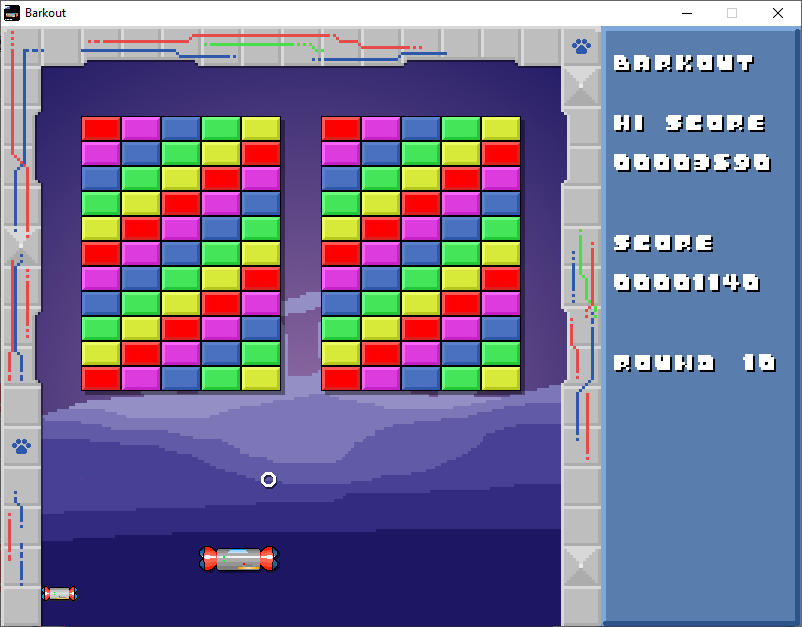
Why make a 2D game in 2024? Well, I like to make the sorts of games I used to play as a child in the 80s and 90s, and Arkanoid was one of my favourites, and one of the few I actually owned a genuine copy of for my Amstrad CPC6128.
Barkout is available in source code form, as well as a Windows 64 bit installer, from the game homepage which can be found by following the "Free Games!" link in the top menu or right here
It's a very vaguely dog-themed Arkanoid / Breakout clone coded in C making use of SDL for graphics, sound, and input.
If you've played Arkanoid, you know what to expect: balls, bricks, bonuses and baddies.
Why make a 2D game in 2024? Well, I like to make the sorts of games I used to play as a child in the 80s and 90s, and Arkanoid was one of my favourites, and one of the few I actually owned a genuine copy of for my Amstrad CPC6128.
Barkout is available in source code form, as well as a Windows 64 bit installer, from the game homepage which can be found by following the "Free Games!" link in the top menu or right here
When the Dog Dies is a gentle comedy starring Ronnie Corbett and Liza Tarbuck as retiree Sandy Hopper and his younger lodger Delores, respectively. The dog in question is Sandy's mongrel Henry. The series is written by Ian Davidson and Peter Vincent, the same team behind Corbett's 1980s television comedy series, "Sorry!".
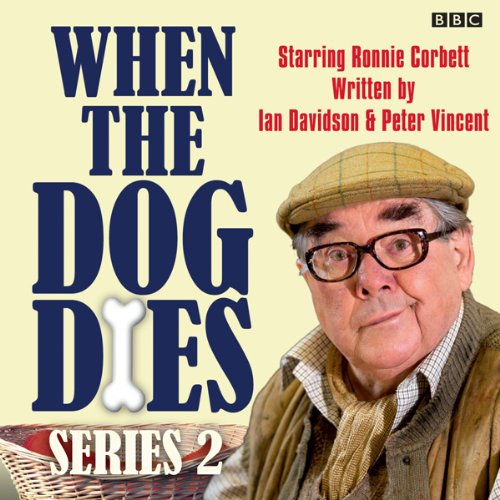
The premise is that Sandy will downsize from his family home and release equity for his children "when the dog dies".
Most of the plots revolve around the various farsical situations Sandy gets himself into, or the schemes of his children to get him to move home or otherwise part with some of his money.
It's a gentle comedy, not one full of belly laughs but one which makes me chuckle from time to time. My biggest complaint is that too many of the characters are just fundamentally unlikeable.
Sandy is a rule-obsessed retired "acting manager" of the Five Feathers, Frinton, forever posting (and changing) house rules to which Delores must abide.
Delores is probably the only truly likeable character in the programme. Relentlessly optimistic, cheerful, and always looking out for Sandy when his family inevitably try to scam him. She also enjoys a good relationship with Henry.
Lance is Sandy's grown up son. A teacher, he's a bit wet and forever on the scrounge to borrow money from Sandy, but he's not entirely unsympathetic. He has an unpleasant, adulterous wife, Victoria, and a teenage daughter called Calais, named as such because she was conceived on a cross-channel ferry.
Ellie is Sandy's grown up daughter. Always sounding like she's on the verge of a breakdown, she considers Sandy's eventual bequest to already be her money, and despairs of him spending any of it before he leaves it to her. She's married to the entirely unlikeable, borderline psychopathic security and surveillance equipment salesman Blake who at various times tries to trick Sandy into giving him power of attorney, cons him into sponsoring him for a road race, and leaves him floating out to sea in a caravan. His schemes often involve tracking or bugging Sandy or his home so he can monitor Sandy's spending. He and Ellie are both convinced that Sandy is romantically involved with Delores. Ellie and Blake's children are Tyson and Zoe, who Blake essentially tortures by insisting on a brutal exercise regime for Tyson and seemingly non-stop sessions of musical instrument practice for Zoe.
Pom-Pom's Mummy is another dog owner who Sandy frequently meets while walking Henry. She initially appears as quite a sympathetic character, but later it becomes more apparent that she too has quite a nasty, jealous streak in her. She covets Sandy and is quite jealous of Delores' relationship with him.
Overall, When the Dog Dies isn't a bad series, it's just not one I'd return to. There are no standout memorable episodes, and I spent a lot of time wondering why Sandy didn't report Blake for his borderline illegal (probably actually illegal, in some cases) activities.
Rating: * *
I've realised that this blog has strayed somewhat from my original aim of it being about my journey of learning Welsh, and more just my opinion on various language-related things.
So, in a return to its true purpose, this post is a review of the book "Yn Ei Gwsg" (In His Sleep) by Bethan Gwanas.
Dafydd walks in his sleep. It's part of the reason, he suspects, for the breakup of his marriage and it gets him into all sorts of odd situations with his neighbours. One morning, however, it takes a more sinister turn when he wakes up covered in blood - not his own - and sets off with his faithful dog Wmffra to follow the bloody footprints to find out to whom the blood belongs.
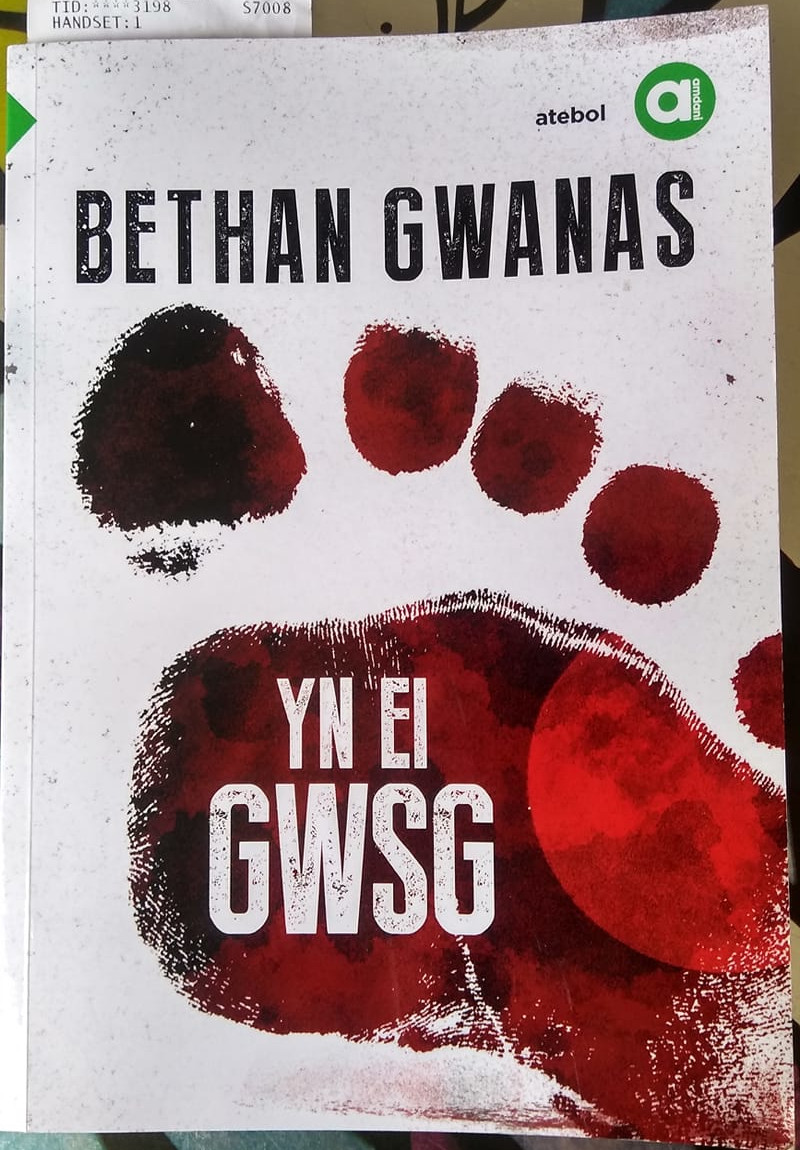
The book is not nearly as dark as that synopsis makes it sound. It's actually very light-hearted, humorous and a touch sad in places. Bethan Gwanas writes novels for native Welsh speakers as well as learners, and I think that helps her keep this novel simple yet clearly aimed at adults. The language used has clearly been thought about so that the level remains suitable for the target audience, yet also shows a progression from start to finish and introduces new words and phrases.
I really enjoyed reading it. Unusually for me, I found I could hardly put it down. I think this was partly because it was genuinely an enjoyable story, and partly because the level was pretty much spot-on for my ability (this is set as Lefel Sylfaen) so I found I was able to read straight through most pages without having to resort to a dictionary (the glossary of new terms at the bottom of each page, as is common for Welsh-for-adults books, helps enormously). The language used is more northern in style, but I didn't find this a hindrance at all - in fact it helped to cement some knowledge of northern dialect that I'm bound to encounter in the wild anyway.
The last book I read before this was "Ffenestri" by Lois Arnold. If you've read up to the end of the Sylfaen level in that, you shouldn't have any problems with this and I'd recommend it as not only a good book for learners, but a good read in its own right.
So, in a return to its true purpose, this post is a review of the book "Yn Ei Gwsg" (In His Sleep) by Bethan Gwanas.
Dafydd walks in his sleep. It's part of the reason, he suspects, for the breakup of his marriage and it gets him into all sorts of odd situations with his neighbours. One morning, however, it takes a more sinister turn when he wakes up covered in blood - not his own - and sets off with his faithful dog Wmffra to follow the bloody footprints to find out to whom the blood belongs.
The book is not nearly as dark as that synopsis makes it sound. It's actually very light-hearted, humorous and a touch sad in places. Bethan Gwanas writes novels for native Welsh speakers as well as learners, and I think that helps her keep this novel simple yet clearly aimed at adults. The language used has clearly been thought about so that the level remains suitable for the target audience, yet also shows a progression from start to finish and introduces new words and phrases.
I really enjoyed reading it. Unusually for me, I found I could hardly put it down. I think this was partly because it was genuinely an enjoyable story, and partly because the level was pretty much spot-on for my ability (this is set as Lefel Sylfaen) so I found I was able to read straight through most pages without having to resort to a dictionary (the glossary of new terms at the bottom of each page, as is common for Welsh-for-adults books, helps enormously). The language used is more northern in style, but I didn't find this a hindrance at all - in fact it helped to cement some knowledge of northern dialect that I'm bound to encounter in the wild anyway.
The last book I read before this was "Ffenestri" by Lois Arnold. If you've read up to the end of the Sylfaen level in that, you shouldn't have any problems with this and I'd recommend it as not only a good book for learners, but a good read in its own right.
Ok, so it's been about seven months since I started learning Welsh in earnest, and he's what I think is hard and what I think is fairly easy about Welsh:
1. Mutations. Letters change at the start of one word depending on what word they follow. However I'm finding that this starts to feel more natural in most circumstances after a while.
2. Versions of "about" and "of/from" for each pronoun. If you're talking about a thing, they're "am" and "o" respectively. But if you're talking about/from me, you, her, him, us or them you're looking at "amdana, amdanat, amdani, amdano, amdanon and amdanyn" and "ohono, ohonot, ohoni, ohono, ohonon and ohonyn"!
3. The letter "Ll". Yes, it counts as one letter. The pronunciation is somewhere between ell and hissing like an angry goose with a headache. For some reason I find it easier to pronounce at the start of a word, like Llawr, than in the middle or end of a word, like Arall or Galla.
4. Conjugations. Well, this is the same for any language, really. Remembering the conjugations of short-form verbs is just one of those things you have to get used to.
5. Yes and no. There are no words for Yes and No in Welsh, you just repeat back (or negate) the appropriate conjugation of the verb in the question. "Do you like cheese?", "I do". "Are you tired?" "I am". "Are you reading?" "I am not". But that's only in the present tense. In the past tense it's usually "Do" for yes and "Naddo" for no. But then for emphatic questions it's "Ie" for yes and "Nage" for no. If the question was asking if there is something with you (see below) you reply with Oes or Nag Oes. Remembering which to use is the hard part.
6. There aren't many words that are similar to other European languages. There are some, mostly more modern words borrowed from English: tacsi, parcio, ffatri, ffôn, beic, etc; and some ecclesiastical words like eglwys (church) and capel (chapel) but not to the extent that you find with Romance or Germanic languages.
Things that are easier than I expected:
1. Mutations. Yes, they're difficult, but actually you get used to them, and in many cases the rules are quite consistent. You just get used to dropping the G in words like gweithio and gweld when they follow a sentence subject. You get used to changing D to Dd in adjectives after "yn", and you get very used to nasal mutations after "fy".
2. Conjugations. Although remembering them is difficult, many of the conjugations are quite consistent and actually fit in quite well with the pronoun they go with.
3. Possession. I've said before about there being no form of "I have a (something)" in Welsh, they instead say something is "with them": Mae ci gyda fi - "There is a dog with me". I got the hang of this much quicker than I thought. I think you just change your way of thinking and everything slots together.
4. The language as a whole. I'm only a beginner. Very much so. But I've been surprised at how much I've covered in such a short space of time. I'm not proficient by any stretch of the imagination, and I can only string together fairly simple sentences, but on the other hand I can make many more types of sentences in Welsh than my partner's daughter can in Spanish; a language she's been learning at school for two years now. I can use the present tense, the past perfect, a sort of imperfect, the future in several forms and some conditional tenses and even a kind of limited subjunctive mood.
On the whole, Welsh has (so far) been easier than I expected. It's not the incomprehensible jumble of letters it always looked like on road signs when we used to visit my Grandma in Rhossili when I was a child. In fact, in many ways it's a lot easier than the languages I'd been taught at school.
Today I completed my first challenge on Say Something In Welsh, which was to say a sentence constructed around each of the below words and phrases out loud within five minutes:
I want to
I'm going to
I can't
I need
What
But
I wanted
I've just started
I've forgotten
I was trying
...that I need...
I must
I would like to
no doubt those passing me thought I was a little odd, as I sat in my car in McDonald's car park talking, mostly, about how I need to feed the dog, eat a burger or go to the pub!
Still, I feel I've achieved something. I shall wear my pink badge with pride (well, my avatar on the forum will).
The next challenge is to record the sentences and post them for the world to see. Oooeeer!
Here's an odd one: the Welsh have no word for "to have", as in to possess something.
The Welsh, though, are a resourceful lot and get around this apparent limitation by saying that something is "with" something else.
I do not have a ball, a ball is with me. Likewise, a new house is with me; a girlfriend is with me; even a beard is with me.
The concept isn't complicated, but I find it tricky to get the word order right. During a conversation at work, I was asked if I knew how to say "The red dog has a ball" in Welsh. I had to think about this. Is the red ball with the dog, or is the dog with the red ball? I eventually settled on the former: mae pêl gyda'r ci coch. I think that's right.
It doesn't trip off my tongue quite as easily as it would in, say, French: Le chien rouge a un ballon. It's a little clumsy and awkward, but that's part of the charm.
This problem isn't limited to possessing an object (or a girlfriend) though. It rears its head when talking about health too. You don't have a sore throat, there is a sore throat with you. You do not have a cold, there is a cold "on you": Mae annwyd arna i.
Let's hope I don't get sick while in Wales; this might take some getting used to.
Welsh, like most European languages, assigns nouns a gender. Some of these are obvious: a man (dyn) is masculine. A woman (menyw or dynes) is feminine. A cat (cath) is feminine. A dog (ci) is masculine. Well, that makes sense to me, at least.
But what's a table? Or a bed? Or love?
And how do we differentiate between them? And how do we learn the gender of a new object?
Well, in other European languages you can tell whether a noun is masculine or feminine by the article in front of it. In French, we have the indefinite articles "un" and "une" and the definite articles "le" and "la". When you learn a new word you also learn the gender. While on holiday in Paris in 2003 I asked "Qu'est-ce que c'est?" while holder up a token to use the toilet in a bar, and I got the answer "un jeton". Un. Masculine. And I've never forgotten that a token, in French, is masculine: "un jeton".
So what about Welsh? Welsh doesn't have an indefinite article at all. There is no way of saying "a table" or "an apple", it's just "bwrdd" and "afal". There IS a definite article ("the table" or "the apple") and it has three forms:
Y for words following and preceding a consonant
Yr for words preceding a vowel, but following a consonant
'r for words following a vowel (regardless of what follows it)
Sadly, none of these differentiate by gender, so it's almost impossible when learning a new word as part of conversation or when reading to tell whether it's masculine or feminine. And it's this that is, so far, the most frustrating thing about learning Welsh. I find myself looking up words that I already know just to determine their gender. While writing this I had to check to see if "coffi" (coffee) is feminine (it isn't).
So, does that matter? Well, yes! Welsh also has no gender-neutral word for "it". When talking about an object you refer to it as either he or she depending on its gender. When talking about the weather, for example, you refer to "she". "Mae hi'n oer" is "it's cold", only it's really "she's cold". And not only that, but certain words mutate in certain ways depending on context and gender. Would a Welsh person understand you if you were to get a gender wrong? Yes, of course. But it would grate. It wouldn't sound right. And if I'm going to learn a language, I'm going to do it right.